
Homemade Peri-Peri Sauce Recipe (Piri Piri Sauce)
This homemade peri peri sauce is the recipe I get asked about more than almost any other condiment on my blog. It’s spicy, tangy, garlicky and so much better than anything you’ll find in a bottle. The whole thing comes together in about 15 minutes in a blender and it keeps in the fridge for weeks, which means one batch covers countless meals.
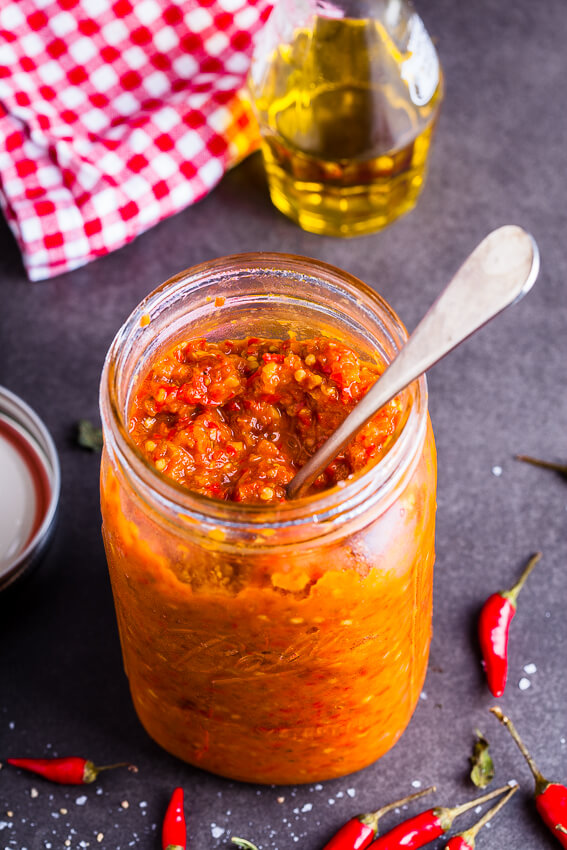
Growing up in South Africa, peri peri sauce was a kitchen staple. It went on everything (literally: my brother would add lashings of peri-peri sauce to any meal my mom cooked). Chicken, steak, shrimp, eggs, basically anything that could handle a little heat.
This is my recipe that I developed over a decade ago, made from scratch with real bird’s eye chilies, and it tastes nothing like the bottled stuff. It’s fresher, brighter, more complex and you can adjust the heat to exactly where you want it. Once you make it yourself, the store-bought versions feel like a pale imitation.
What is peri peri sauce?
Peri peri sauce (also called piri piri sauce) is a hot chili sauce made from African bird’s eye chilies, blended with garlic, onion, vinegar and oil. It originated in Mozambique and was popularized in South Africa and Portugal, where it became the signature sauce behind some of the most famous grilled chicken in the world. If you’ve ever eaten at Nando’s, you’ve tasted a version of it. This is the homemade version and it’s better.
Peri Peri vs Piri Piri: Same Sauce, Different Spelling
If you’ve seen this sauce spelled as peri peri, piri piri, pili pili or even piripiri and wondered if they’re all the same thing, they are. The different spellings come from different languages and regions but they all refer to the same chili-based sauce made from African bird’s eye chilies.
“Piri piri” comes from the Swahili word for “pepper pepper” and is the spelling most commonly used in Portugal and Mozambique. “Peri peri” is the spelling that became popular in South Africa, largely through Nando’s, and is the version most English speakers recognize. In parts of Central and West Africa you’ll see “pili pili” instead. Regardless of how you spell it, the sauce is the same: a vibrant, spicy, garlicky chili sauce built around African bird’s eye chilies.
For this recipe I use “peri peri” because that’s how I grew up saying it in South Africa, but if you searched for “piri piri sauce” you’re in exactly the right place.
Ingredients and Substitutions
The key ingredient in any peri peri sauce is the African bird’s eye chili. These small, fiery red chilies are what give peri peri its signature sharp, bright heat and they’re found in markets and stores all over Southern Africa. If you can get your hands on them, use them.
The flavor is worth the effort. If you can’t find them, Thai chilies are the closest substitute in both heat level and flavor. Serrano peppers or Fresno peppers will work for a milder version but the heat profile will be slightly different.
- African Bird’s eye chillies. The star of the sauce. For a milder sauce, remove the seeds and white membrane before blending. For a hotter sauce, leave everything in. If you can only find dried bird’s eye chilies, rehydrate them in warm water for 20 minutes before using.
- Red bell pepper. This is the secret to a well-balanced peri peri sauce. The bell pepper adds sweetness, body and a gorgeous red color without adding any heat. It rounds out the sharp bite of the bird’s eye chilies and gives the sauce a fuller, more complex flavor. Don’t skip it even if your sauce is meant to be hot. It balances the heat rather than diluting it. For a milder sauce, increase the bell pepper and reduce the chilies.
- Red onion. Adds a subtle sweetness and depth to the sauce base. Red onion is slightly milder and sweeter than white or yellow onion, which works better in a raw-blended sauce like this. White onion is a fine substitute if that’s what you have.
- Fresh garlic cloves. Garlic is essential to peri peri sauce. Use fresh cloves rather than jarred or powdered. The flavor difference in a sauce this simple is noticeable. I use an entire head of garlic (approximately 10 cloves) for this volume of sauce.
- Tomatoes. Fresh tomatoes add body, natural acidity and a subtle sweetness that ties the sauce together. Use ripe, red tomatoes for the best flavor. Roma tomatoes work well because they have less water content and a meatier texture. In a pinch, canned whole tomatoes (drained) work as a substitute.
- Olive oil. I used extra-virgin olive oil but any neutral oil (vegetable, canola, sunflower) works if you prefer a cleaner-tasting sauce. The oil adds body and helps emulsify everything into a smooth, pourable consistency. It also helps the sauce keep longer in the fridge.
- Red wine vinegar. The acidity from the vinegar is what gives peri peri sauce its tangy bite and acts as a natural preservative that extends the shelf life. Red wine vinegar adds a slightly more complex, rounded acidity than white vinegar. White vinegar or apple cider vinegar both work as substitutes. Apple cider vinegar gives a slightly sweeter, mellower tang.
- Fresh lemon juice. Adds a bright, fresh citrus note that lifts the entire sauce. The lemon works alongside the vinegar to create that characteristic tangy brightness that makes peri peri so addictive. Use freshly squeezed rather than bottled.
- Bay leaves. An unexpected ingredient in a chili sauce but bay leaves add a subtle, herbaceous depth that rounds out the flavor.
- Dried oregano. Dried oregano is better than fresh here because the concentrated flavor holds up against the strong chilies and vinegar.
- Smoked paprika. Adds a warm smokiness and deepens the red color of the sauce. It’s not traditional in every peri peri recipe but I love adding it. The smokiness adds another dimension that makes the sauce taste more complex without adding heat. Regular paprika works if you don’t have smoked but you’ll lose that smoky undertone.
- Salt and black pepper. Season the sauce generously. The other flavors (chili, garlic, vinegar, lemon) are all bold and they need enough salt to bring them into balance. Add gradually, taste and adjust. You can always add more but you can’t take it away.
- Sugar. Just a small amount. The sugar isn’t there to make the sauce sweet. It’s there to balance the acidity from the vinegar and lemon and to take the sharp edge off the chilies. Think of it as a flavor smoother rather than a sweetener. Taste the sauce without it first and add only if the acidity feels too aggressive.


How To Make Peri-Peri Sauce
1. Blend
Combine all the ingredients in the bowl of a food processor and blend into a smooth paste.
2. Cook
Transfer the blended paste to a saucepan and bring to a gentle simmer. Cook for 20 minutes, stirring regularly. Taste and adjust seasoning as needed.
3. Store
Transfer to jars or an airtight container and allow to cool completely before storing in the fridge for up to 3 weeks.
Can I make this in advance?
You can store the cooked sauce in the refrigerator for up to 3 weeks in an airtight container or jar and it can be frozen for up to 3 months. Transfer the sauce to freezer-safe containers before freezing.
How Spicy Is Peri Peri Sauce?
Traditional peri peri sauce is hot. Bird’s eye chilies sit at around 50,000 to 100,000 on the Scoville scale, which puts them well above jalapeños (2,000 to 8,000) but below habaneros (100,000 to 350,000). The heat is sharp and immediate but it doesn’t linger the way some hotter chilies do.
That said, homemade peri peri sauce is completely customizable. You control the heat.
- For a milder sauce: Reduce the number of bird’s eye chilies and add a red bell pepper to the blend. The bell pepper adds volume, sweetness and color without adding heat. You get the flavor of peri peri without the burn. This is a good approach if you’re serving it to kids or anyone who prefers a gentler sauce.
- For a medium sauce: Use the full amount of chilies but keep the seeds out. The seeds and the white membrane inside the chili are where most of the heat lives. Removing them brings the heat down noticeably while keeping the chili flavor intact.
- For a hot sauce: Use the full amount of chilies with the seeds in. This is the traditional heat level and the one I grew up with. It’s spicy but not painful. You can still taste the garlic, the vinegar and the citrus underneath the heat.
- For an extra hot sauce: Increase the number of bird’s eye chilies or add a habanero or scotch bonnet to the blend. This pushes the sauce into serious hot sauce territory and is only for people who genuinely enjoy high heat.
The beauty of making it from scratch is that you can taste as you go and stop when the heat is right for you. Start with fewer chilies, blend, taste and add more if you want it hotter. You can always add heat but you can’t take it away.
Serving Suggestions
Peri peri sauce is one of the most versatile condiments you can have in your fridge. It goes far beyond just chicken.
- Chicken. This is the classic pairing. Use it as a marinade, a basting sauce or a finishing drizzle. It works on every cut: whole chicken, skewers/espetada, thighs, drumsticks, wings and breast. My Peri Peri Chicken uses this sauce as the base. If you like chicken livers, you HAVE to try my Peri-Peri Chicken Livers. They are delectable!
- Shrimp/Prawns. Peri peri and seafood are a natural combination. Toss shrimp in the sauce before grilling or pan frying for a quick, spicy dinner.
- Steak. A spoonful of peri peri sauce alongside a grilled steak adds heat and acidity that cuts through the richness of the beef. Use it as a finishing sauce rather than a marinade so the flavor of the meat still comes through.
- Pasta. Peri-peri adds just the right amount of heat to a delicious creamy pasta sauce. We love this Peri-Peri Chicken Pasta and Peri-Peri Prawn Pasta.
- Peri peri bowls. Build a bowl with rice, grilled chicken or shrimp, roasted vegetables and a generous drizzle of peri peri sauce. My Peri Peri Chicken Bowls are a weeknight favorite and the sauce ties everything together.
- Eggs. A few drops of peri peri sauce on scrambled eggs, fried eggs or an omelet is one of the simplest breakfast upgrades there is. The heat and acidity wake everything up.
- Vegetables. Drizzle over roasted cauliflower, grilled corn, roasted sweet potatoes or charred broccoli. The sauce adds a flavor dimension that turns basic vegetables into something you’d happily eat as a main course.
- As a dipping sauce. Serve it straight as a dipping sauce for fries, wedges, grilled bread or spring rolls. Thin it slightly with a squeeze of extra lemon juice if you want a more pourable consistency.
- Mixed into mayo or yogurt. Stir a spoonful into mayonnaise for a spicy peri peri aioli or into Greek yogurt for a creamy peri peri dipping sauce. Both are great with chicken tenders, fries or as a sandwich spread.
Video
Ingredients
- 2 red onions peeled and roughly chopped
- 1 head of garlic cloves peeled and roughly chopped
- 1 cup African bird’s eye chillies stems removed
- 2 red bell peppers seeds removed and roughly chopped
- 3 ripe tomatoes skins removed and roughly chopped
- 4 tablespoons olive oil
- juice and zest of 3 lemons
- 1/3 cup red wine vinegar
- 2 tablespoons sugar
- 1 tablespoon salt
- 1 teaspoon cracked black pepper
- 2 bay leaves
- 1 tablespoon dried oregano
- 1 tablespoon smoked paprika
Instructions
- Combine all the ingredients in the bowl of a food processor/blender and mix until all the ingredients are finely chopped and the mixture is quite saucy.
- Transfer to a saucepan over medium heat and simmer for 20 minutes, stirring every few minutes to prevent the sauce from burning.
- After 20 minutes, check the seasoning and adjust. The sauce should be well balanced with a good kick of spice and sourness from the lemon and vinegar.
- Pour into jars/bottles and keep in the refrigerator for up to 2 weeks.
Notes
Nutrition
Frequently Asked Questions
They are the same sauce – ‘peri peri’ is the spelling used in South Africa and most English-speaking markets, while ‘piri piri’ is the Portuguese spelling. Both names come from the Swahili word for bird’s eye chili. The sauce originated in Mozambique and was made famous worldwide through Nando’s.
Homemade peri peri sauce can range from mild to very hot depending on the number of bird’s eye chilies used. Bird’s eye chilies measure 50,000–100,000 Scoville units – significantly hotter than a jalapeño. For a mild sauce, use 2–3 chilies. For medium heat, use 5–6. For full Nando’s-style heat, use 8–10. Remove seeds and membranes to reduce heat while keeping the flavor.
Yes, it is one of its best uses. Marinate chicken, shrimp, fish or pork in 3–4 tablespoons of peri peri sauce for at least 30 minutes (or overnight for best flavor). The acid from the vinegar helps tenderize the meat while the chilies infuse heat throughout.
Stored in a sealed jar in the refrigerator, homemade peri peri sauce keeps for up to 2 weeks. The vinegar acts as a natural preservative. For longer storage, freeze it in ice cube trays and transfer to a freezer bag – it keeps for up to 3 months frozen
Pequin peppers or Thai red chilies are the closest substitutes in terms of heat and flavor. For a milder version, use red Fresno chilies or half a teaspoon of cayenne pepper per chili. Avoid substituting with sweet bell peppers – they will produce a completely different flavor profile.
Wow best peri-peri recipe I have found on internet yet. Will try it tomorrow with chicken. Thank you !!!!
Can the red whine be substituted with something else?
Water or stock.
Am I reading the recipe correctly that the bay leaves should be chopped with all of the veggies? Thanks!
Yes, I blend everything together but you can leave them out and cook them whole in the sauce too.
Hi! This recipe sounds awesome, but can you give an approximate value in grams for 1 cup of the fresh chillies? 50-100g? Thanks in advance!!
100-125g should be perfect but feel free to add more or less to suit your own taste.
I just made this sauce, its very yummy!
I cheated a bit though, I was a bit lazy so I cut the lemons in half, removed the pips and threw the lemon half into the blender.
Worked out great.
Incidentally we used to get rotisserie roast chicken from Fernando’s Dads shop in Rosettenville long before he even started Nando’s.
Would it be possible to do this recipe without tomatoes? But the same measurements for the other ingredients.
Yup!
I grew my own peri peri peppers so I don’t know how they would compare with African grown ones but they are quite hot. I really like this recipe but it says it makes 3 cups but I ended up with 7 cups. So a lot of friends ended up with little bottles of peri peri sauce. One person can only use so much hot sauce especially since my 2 plants are still busily producing more peppers.
Would love to try this…but hubby can’t take much heat. Any suggestions to making it milder? I assume using less peppers, but should the missing amount be substituted with something else? Help please!
You could use red bell peppers instead of chillies.
Mine tasted very vinegary. And very spicy.
It’s meant to be very spicy because of the chillies used. The vinegar-flavor should be cooked off while the sauce is simmering.
Just made this for the first time and it’s awesome ??
Will be making it again ?
Thanks for the recipe!
Hi, found your recipe three years ago. I now make this annually. I triple the batch, put in glass jars and into the fridge. Each batch lasts the year no problem.
Amazing!!
I know this is an old comment, but just wondering if you do anything special during the jarring process that makes them last all year? (do you boil, remove all air, etc?)
Lovely sauce. Tastes almost exactly the same as the one I remember. I dry roasted all the veggies except the peppers. May add more onion next time to see if I can get it closer to the sauce I remember.
Either way all I have to say is Yum! Glad I found this recipe. Will be making a lot as I have already used up half of the batch I made yesterday. And now I have another hot sauce recipe to use up all the peppers I grow in the garden.
Thanks for a fabulous recipe that will be one of my staples!
PS. There was a South African habanero sauce that my husband’s rugby mate would bring me when he came to the U.S. Very simple…habanero, vinegar, onions, and garlic. No carrots (like Belize/Caribbean or Mexican habanero sauce). If you have a recipe for that I would greatly appreciate it.
i think this is going to be good. iI”am going to make this tommorow.
This is a great recipe. I make a similar one with the same ingredient, but before blending I char the peppers and tomatoes over a gas flame or braai fire. This gives the sauce a smokey taste. I also dry roast my garlic.
Regards
Robin
Love the recipe! Thank you very much for sharing it!
Quick question – I’m looking to preserve this using water bath canning so I can hopefully make enough to last a few months without the need to keep remaking it – everything I’ve read online suggests this should be plenty acidic enough to be water bath canned and stored on a normal shelf for over a year – can you confirm/comment on this?
Many thanks!
Because I’ve never canned this for it to last months I don’t feel comfortable giving advice, unfortunately. But if you are used to canning, I would love to know if you do can this recipe what the results are.
Does the African bird’s-eye chili pepper have a certain flavor that’s unique for this sauce? Or could I substitute another type of pepper?
It is unique but not so much that it would ruin the sauce if you used another pepper. I think jalapenos, serranos, etc. will all work well.
Hi Alida, I really want to make this recipe it reminds me of the steak I ate during my visit to south africa that was served on a bed of chicken livers. Is it ok to take of the seeds from the chillies or do they need be put in without taking them out.
You can definitely take them out.
It’s GREAT! Done it half a dozen times. This is the best peri-peri sauce i’ve tried and believe me, i like my food hot and spicy. All my friends love it. Thanks a lot love for sharing
Alida, it looks so yummy! I love the step-by-step instructions, making it an easy recipe to follow!
Hope you love it!
Skids, I have some dried piri piri peppers. Have you ever used them for this? How did you rehydrate them and would you use a cup once rehydrated?
No I’ve never used dry peppers, I think the finished consistency and flavor of the sauce will be a lot different when using dried.
Great sauce. I roasted the the peppers and onions first to add to the sweetness, then blended.
Alida, thanks! Very tasty sauce turned out. Very cool photos!
So glad you liked it. Thanks Alyssa!
Hi there,
I’m going to attempt you recipe this weekend. If our sterilize the bottles, how long do you think this will preserve for.
I’ve read in some blogs if you use citric acid it will persevere for longer. Any idea if this will work?
It should last for a couple of months but as I haven’t tested it I can’t say for certain and I have never used citric acid for preserving unfortunately.
Best piri piri sauce ever! Love it!!!!
Thanks!